



A detailed Runway vs invideo Agent comparison covering pricing, credit costs, camera control, character consistency, AI agents, and project memory.
Runway has earned a specific reputation in the AI video space: “the director’s tool,” built around giving creators precise, manual control over camera movement, motion, and scene composition rather than handing back a single black-box result. invideo takes a different approach, built around an agent that holds an entire project’s context and routes each shot to whichever model fits, rather than one platform’s own proprietary control system.
Two names that keep coming up for anyone doing serious AI filmmaking work: invideo Agent and Runway.
Comparing them isn’t really about which one makes a technically sharper single clip. Once you factor in what happens across an entire multi-shot production, what the credit economics actually cost once you account for iteration, and how much manual direction you’re expected to provide yourself, the decision looks different.
Invideo vs. Runway: A Quick Overview
Runway, a New York-based company backed by Google, Nvidia, and Salesforce at a $1.5 billion valuation, built its reputation on Gen-4 and the current flagship Gen-4.5, models widely regarded as producing some of the most cinematically coherent AI video available, with motion physics, subject consistency, and lighting behavior that approaches professional VFX quality. It’s used by Hollywood studios and favored heavily by ad agencies and production teams specifically for its camera control.
Invideo Agent works from a different premise: rather than one platform’s own flagship model as the centerpiece, it routes each shot to whichever of 200+ underlying models, including Runway’s own Gen-4 family alongside Veo, Kling, and Seedance, actually fits that shot’s specific need, holding the entire project’s context in persistent memory across every shot rather than treating each generation as independent.
Pricing: What The Credit Math Actually Costs
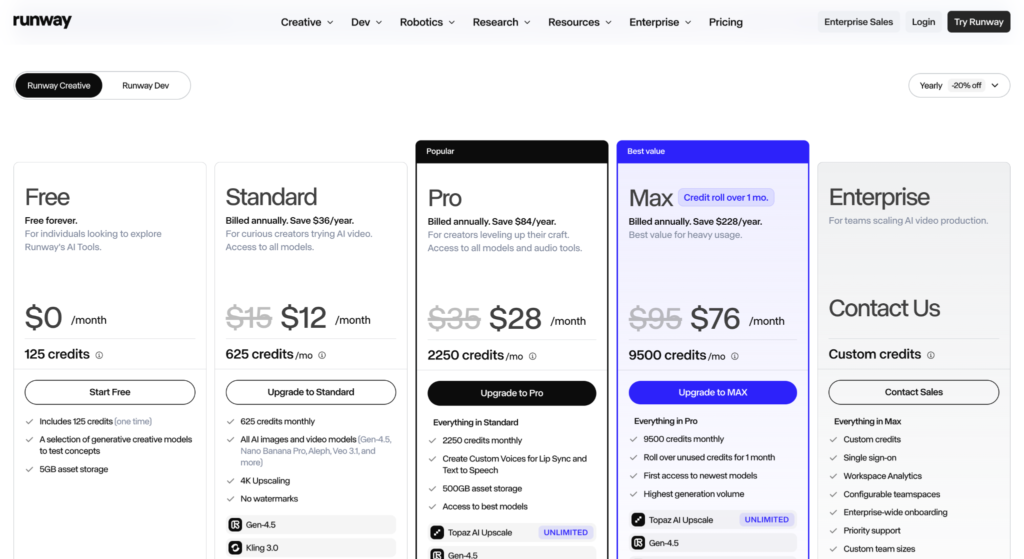
Runway’s free tier grants 125 one-time credits (roughly 8 seconds of Gen-4 video), watermarked, with access limited to Gen-4 Turbo. As of May 2026, the Standard tier dropped to $12/month (billed annually) for 625 monthly credits, and here’s the part worth being precise about: at 625 credits, that translates to roughly 25 seconds of Gen-4.5 video per month, 52 seconds of Gen-4, or 125 seconds of Gen-4 Turbo. One independent breakdown notes plainly that if Gen-4.5 is your primary model, 25 seconds a month “won’t support daily creative work.”
Pro runs $28/month for 2,250 credits, and Max runs $76-99/month for 9,500 credits. Every paid tier from Standard up unlocks the full model library, Gen-4.5, Gen-4, Act-Two, Aleph, Workflows, Veo 3.1, Kling 3.0 Pro, Seedance 2.0, and more, rather than gating specific models behind higher tiers.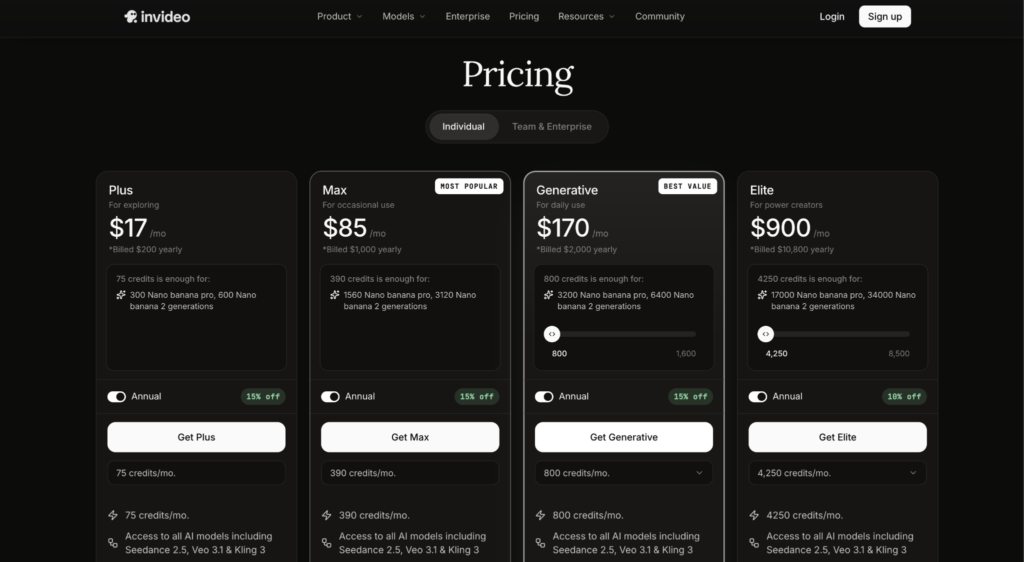
invideo’s pricing runs across four tiers. Plus starts at $17/month (billed $200/year) with 75 monthly credits, aimed at getting started with the full model library rather than a single flagship model. Max runs $85/month (billed $1,000/year) for 390 credits, a step up for regular ongoing production. Generative sits at $170/month (billed $2,000/year) for 800-1,600 credits, scaling for teams running heavier volume. Elite tops out at $900/month (billed $10,800/year) for 4,250-8,500 credits, aimed at high-volume studio or agency production.
Annual billing carries a discount across all tiers (15% off Plus, Max, and Generative; 10% off Elite), and — the detail that actually matters for a direct comparison with Runway — every tier from the entry price point includes the same full 200+ model library, rather than gating specific flagship models like Runway does starting at its Standard tier.
Where invideo Agent Two Pulls Ahead
This is the part a pure model-quality comparison misses, since it’s a difference in what layer of the problem each platform is solving.
Persistent project memory. invideo Agent holds an entire project’s world, a film’s look, tone, and treatment, or a brand’s guidelines, in a standing “Context,” with individual “Briefs” for each scene or campaign asset living inside it. Runway’s Director Mode helps keep a character consistent while building a multi-scene script within one project, which solves a related but narrower problem than a persistent context carried automatically across an entire production’s full run.
Expert Agents that brief each other. invideo lets a filmmaker build a crew of specialized agents, a DOP, a casting director, a costume stylist, just by writing each one a job description, and they coordinate automatically, briefing each other without the human needing to relay information manually. Runway’s Workflows feature lets users build custom pipelines, but it’s a sequence of steps a single user configures, not a coordinated crew of independently-briefed specialist agents.
Reading and understanding existing footage. invideo Agent Two can read an uploaded rough cut directly and flag continuity errors, in one internal demonstration, catching a prop that changed between two shots and a color-grade inconsistency elsewhere in the same film, without being asked to look for anything specific. Runway’s Aleph is a genuinely capable in-video editing tool for prompted changes to existing footage, but it works on direct instruction for a specific edit rather than proactively reading a full cut for continuity problems across an entire project.
Camera Control And Editing
It’s worth being direct here: Runway’s camera control is a real, well-earned strength. Zoom, pan, dolly, and arc movements directed the way an actual camera operator would, plus Motion Brush 3.0, painting specific areas of an image to direct movement with distinct vector controls for speed and direction, give a level of manual precision that’s part of why agencies specifically favor Runway for production work.
invideo Agent’s AI VFX and camera preset system covers similar ground through named moves (dolly, pan, tilt, track, jib, 360-degree orbit) applied to a still image or existing footage, and with Agent Two specifically, the agent can read a camera movement from an uploaded reference clip and reapply that exact movement to a new scene, a different kind of precision than Runway’s manual painting-and-vector-control approach, useful when a director has a specific reference in mind but would rather point to an example than hand-direct every parameter.
Character Consistency
Runway’s Gen-4 introduced genuine reference-image character consistency, a real advance over earlier generations where characters would morph across shots, maintaining consistent appearance, clothing, and features across multiple scenes, camera angles, and lighting conditions. Its spatial understanding also keeps environments coherent across camera movements.
invideo Agent locks a character through a multi-angle reference sheet used as the standard every later shot gets checked against, with a self-checking mechanism that flags a shot returning the wrong face, wardrobe, or location, a genuine priority for anyone doing serious AI filmmaking. An independent Physion-Arc benchmark, 100 prompts, 700 videos across 7 agents, scored invideo Agent One highest on Identity Consistency (79.6) of any agent tested, though that same evaluation also flagged invideo Agent One with the highest celebrity-resemblance risk of the cohort on a separate safety scan, a real caveat alongside the consistency win.
Who Each Platform Actually Suits
Runway suits a production that wants precise, hands-on manual control over camera movement and scene composition, values Aleph’s editing capabilities and Act-Two’s performance capture for animation work, and has the budget discipline to plan around its credit economics, particularly if Gen-4.5’s top-tier quality is the specific draw.
invideo Agent suits an actual project in AI filmmaking, a series, a multi-scene campaign, a brand rollout, where persistent memory across many shots and sessions, a coordinated crew of specialized sub-agents, and the ability to read and act on already-shot footage matter more than manually directing every camera parameter on every shot yourself.
Common Mistakes When Comparing The Two
- Judging Runway’s pricing without doing the credit math. 625 monthly credits sounds generous until you realize that’s only about 25 seconds of the flagship Gen-4.5 model, plan around actual seconds of output, not the credit number alone.
- Assuming Runway’s Director Mode is equivalent to project-wide persistent memory. It helps with consistency across a script within one project; it’s a narrower solution than a Context system carried automatically across an entire multi-episode production.
- Treating manual camera control and AI filmmaking model routing as solving the same problem. Runway’s strength is precise, hands-on direction; invideo Agent’s strength is holding context and routing shots automatically, different workflows for different priorities.
- Ignoring the learning curve. Runway is frequently described as powerful but complex, with real time investment required to use its manual controls effectively.
- Treating a benchmark win as the whole picture. invideo’s strong Identity Consistency score comes with a documented celebrity-resemblance caveat from the same evaluation.
FAQ
It depends on usage. Runway’s Standard tier is cheaper on paper ($12/month) but only provides about 25 seconds of its flagship Gen-4.5 model monthly, heavier use requires Pro or Max. invideo’s tiers include full model library access starting at $17/month without the same per-second credit constraint on a specific flagship model.
Runway is specifically known for this, manual zoom, pan, dolly, and arc control plus Motion Brush’s vector-based movement direction make it “the director’s tool” for agencies that want hands-on precision. invideo Agent covers similar named camera moves and, with Agent Two, can also read and reapply a camera movement directly from an uploaded reference clip.
Not in the same way. Runway’s Director Mode helps maintain character consistency within one multi-scene script, but it doesn’t carry a standing, project-wide “world memory”, locked characters, locations, and style, automatically across an entire production the way invideo Agent Two’s Context and Briefs system does.
Manual camera control precision and Aleph’s in-video editing capabilities are both genuinely well-regarded in AI filmmaking circles, particularly for agencies and production teams that want hands-on, frame-level direction rather than describing intent to an agent and letting it route the work.